For decades the role of a security camera was relatively straightforward, capture video and transmit it to a monitor or recorder where security personnel could review footage live or post incident. Even as analytics emerged, most processing took place on dedicated servers or within centralized video management systems. Today, that model is rapidly changing.
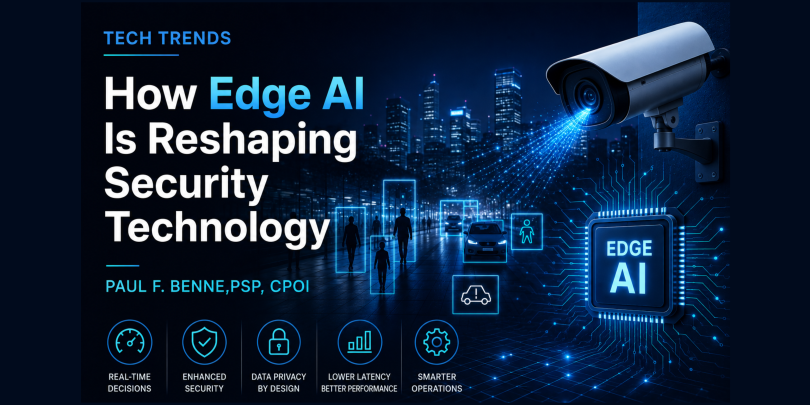
A new generation of intelligent cameras is transforming the architecture of physical security systems by moving artificial intelligence directly to the edge. Rather than functioning solely as image-capture devices, cameras are becoming powerful computing platforms capable of analyzing video, generating actionable intelligence, and triggering automated responses in real time.
For security integrators, this evolution represents one of the most significant technology shifts in the industry since the migration from analog to IP video.
Edge AI refers to the execution of artificial intelligence algorithms directly on a device rather than sending data to a centralized server or cloud platform for processing. Advances in processors, memory, and specialized AI chipsets (e.g.: Hanwha – Wisenet 9, Axis – ARTPEC 9) have enabled modern cameras to perform increasingly sophisticated analytics without relying on external computing resources.
This shift is being driven by several practical considerations. Organizations want faster response times, lower bandwidth consumption, reduced infrastructure costs, and greater operational resilience. Processing video at the camera allows events to be analyzed immediately without the delays associated with transmitting large volumes of data across networks. The result is a camera that not only captures images but also interprets what it sees.
Traditional video analytics often struggled with accuracy. Simple motion detection generated excessive nuisance alarms caused by shadows, weather conditions, animals, or environmental changes. Security operators became accustomed to filtering out false alerts, reducing confidence in automated systems.
Modern edge AI is significantly more sophisticated. Cameras can now distinguish between people, vehicles, bicycles, and other objects with a high degree of accuracy. Advanced models can identify specific behaviors, monitor occupancy levels, detect loitering, recognize direction of travel, and classify activities occurring within a scene.
Rather than alerting operators whenever movement occurs, intelligent cameras can notify personnel only when meaningful events take place. This dramatically improves operational efficiency and reduces alarm fatigue.
For organizations facing staffing shortages or monitoring large facilities, the ability to focus attention on relevant events has become a compelling value proposition.
The benefits of edge AI extend well beyond security operations. Increasingly, organizations are seeking solutions that provide both security and business intelligence.
Retail organizations are using camera analytics to understand traffic patterns, measure occupancy, and identify operational bottlenecks. Transportation facilities can monitor vehicle flow and congestion. Commercial real estate operators can evaluate building utilization and visitor activity. Healthcare facilities can improve situational awareness in high-traffic areas.
This convergence of security and operational intelligence is changing how end users evaluate technology investments. Cameras are no longer viewed solely as security devices; they are becoming sensors that generate actionable data for multiple stakeholders throughout an organization. As a result, security projects are increasingly attracting interest from operations, facilities management, risk management, and executive leadership teams.
The migration of intelligence to the edge is also influencing system design. Historically, advanced analytics often required dedicated servers equipped with substantial processing power. These systems increased infrastructure costs, introduced complexity, and created potential points of failure.
By processing data locally, edge AI reduces the burden on centralized resources. Only metadata, alerts, or relevant video clips may need to traverse the network. This can significantly reduce bandwidth requirements and storage consumption while improving overall system responsiveness.
For integrators, this shift presents opportunities to simplify deployments while delivering enhanced functionality. However, it also requires a deeper understanding of camera capabilities, AI model performance, and application-specific requirements. Remember, not all edge analytics are created equal, and selecting the appropriate technology for a given use case needs to be proven in the design phase before being deployed.
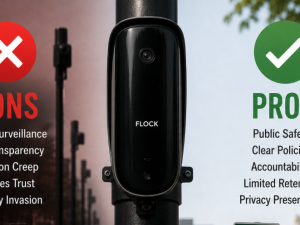
As organizations adopt AI-powered surveillance, privacy concerns continue to grow. Interestingly, edge AI may offer advantages in this area.
When video is analyzed locally and only metadata is transmitted or stored, organizations can reduce the amount of sensitive footage moving across networks or being retained in centralized repositories. Some solutions now support real-time redaction, privacy masking, and selective data retention strategies that help address regulatory and privacy concerns.
At the same time, increased intelligence raises important questions regarding transparency, data governance, and acceptable use. Organizations must carefully define policies governing how AI-generated information is collected, stored, accessed, and utilized. Security professionals should expect privacy and governance considerations to become increasingly important components of future deployments.
The emergence of intelligent cameras also expands cybersecurity considerations. Every AI-enabled camera is effectively a network-connected computing device with processing power, software, firmware, and stored data.
This reality reinforces the need for strong cybersecurity practices throughout the system lifecycle. Secure configurations, firmware management, network segmentation, credential management, and ongoing vulnerability monitoring should be standard components of every deployment.
As enterprise IT teams become more involved in physical security decisions, integrators who can demonstrate cybersecurity competence will be better positioned to win and retain business.
The physical security industry is still in the early stages of the edge AI transformation. Processing power continues to increase while AI models become more sophisticated and efficient. Future cameras will likely support multiple simultaneous analytics, deeper contextual understanding, and tighter integration with access control, visitor management, and incident management platforms.
The most important takeaway for integrators is that the camera is evolving from a passive recording device into an intelligent decision-support platform. Success will depend not simply on deploying hardware, but on understanding how data, analytics, automation, cybersecurity, and operational workflows intersect.
The organizations that embrace this shift will be positioned to deliver greater value to their clients. Those that continue viewing cameras solely as video capture devices may find themselves competing in a market that has fundamentally changed.