The security industry is undergoing one of the most dramatic transformations in its history. A wave of AI-driven innovation, rapid advancements in autonomous systems, and the mainstreaming of drones and robotics are reshaping how organizations protect people, property, and operations. What once felt like distant future technology has now become essential infrastructure, and the pace of change is only accelerating. As we welcome 2026, security practitioners face a defining moment. They must adapt to new technological realities or risk being outpaced by competitors who are willing to evolve.
The message is not subtle. The days of traditional, hardware-centric security are fading. The industry is moving toward intelligent systems that can analyze, interpret, and respond with unprecedented speed and accuracy. Security professionals who embrace this shift will thrive in an era of smarter, more predictive protection. Those who ignore it may soon find themselves obsolete.
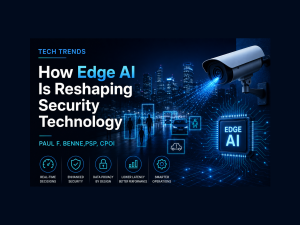
One of the most important changes shaping the industry is the rise of artificial intelligence. AI now sits at the core of modern security operations, powering video analytics, access control decisions, perimeter detection, and real-time threat interpretation. It provides capabilities that were once impossible, detecting unusual behavior patterns, identifying potential intruders, recognizing objects or weapons, and alerting operators before an event fully unfolds. For decades, security operations were limited by human capacity. No team can monitor hundreds of cameras or analyze complex behavioral cues at all hours. AI effectively removes these constraints, allowing security to become proactive rather than reactive.
Organizations that fail to integrate AI into their operations will struggle with the limitations of traditional monitoring. Missed incidents, false alarms, slow response times, and inflated workload will become increasingly difficult to justify as competitors operate with far more precision and efficiency. Security professionals must develop fluency in how AI systems work, where they are most effective, and how to manage them responsibly. This includes understanding model accuracy, data governance, privacy implications, and system integration. It also means upgrading legacy infrastructure and redesigning operational workflows, so humans focus on decision-making while AI handles detection. The security professional who does not master AI technology will quickly find their expertise outdated.
Equally transformative is the rise of drones, robotics, and autonomous response systems. These tools are no longer experimental, they are being deployed in live environments across campuses, industrial facilities, municipalities, and large commercial properties. Companies like www.LandSky.ai are leading innovation in this area. Drones can patrol perimeters, respond instantly to alarms, and provide dynamic overhead visibility. Ground robots can navigate complex environments, conduct routine patrols, and capture video, audio, thermal data, and environmental metrics far beyond human sensory capability. These systems are fundamentally changing how coverage is achieved. A guard on foot or a fixed camera can see only so much. Aerial and mobile robotics introduce new dimensions of surveillance and rapid response, giving security teams reach and visibility previously unattainable.
Autonomous systems also reduce reliance on large guard forces, which helps organizations facing rising labor costs and staffing shortages. They can operate continuously, without fatigue or distraction, and they integrate seamlessly with AI-powered command platforms. This combination creates a force multiplier effect, enabling smaller teams to manage larger and more complex environments with greater effectiveness. To take advantage of this shift, security leaders must educate themselves on operational planning for drones and robots, understand evolving FAA guidelines, develop automated patrol strategies, and learn how to integrate autonomous systems with existing infrastructure. Those who understand how to deploy these technologies will deliver solutions that are modern, efficient, and commercially competitive. Those who do not will fall behind companies capable of offering full-spectrum autonomous security services.
Beyond mastering technologies themselves, security professionals must undergo a deeper evolution in how they define their roles. For many years, integrators and consultants were viewed primarily as specialists, people who designed and installed systems, maintained equipment, or managed the technology once deployed. In the emerging landscape, this narrow definition of expertise is no longer sufficient. The security leader of 2026 must be a strategic technology advisor, capable of guiding organizations through complex digital transformation.
Organizations need experts who understand not only devices and systems, but also cybersecurity principles, data management, AI governance, regulatory frameworks, cloud architecture, and long-term technology planning. Clients increasingly expect their security partners to help them evaluate emerging technologies, plan multi-year upgrades, mitigate legal and privacy concerns, and justify investments with clear operational returns. The integrator or consultant who embraces this leadership role will be valued as a trusted partner, not just a service provider. Those who remain focused solely on installation or traditional guard operations may find themselves replaced by firms offering broader, more strategic capabilities.
The shift from technician to strategist requires continuous learning. AI, autonomy, and cloud-based security will evolve rapidly, and professionals must keep pace through ongoing education, vendor collaboration, and cross-disciplinary knowledge. They must also refine their ability to communicate complex technology in clear, practical terms for executives and stakeholders. Ultimately, the security professional who can interpret the future and chart a path toward it will be the one who succeeds.
As we enter 2026, the industry stands at a critical crossroads. Technology is reshaping every aspect of security operations, from detection to response to management. AI, drones, and autonomous systems will define how organizations identify and mitigate risk, and the expectations of clients will shift toward smarter, more integrated, and more predictive protection strategies.
Survival in this environment requires adaptation now, not later. Security leaders must learn to harness AI intelligence, embrace autonomous tools, and elevate their role into strategic security technology leadership. The future of security belongs to those who evolve with it. Those who resist will quickly find themselves left behind.